
Week 5: Luck of the Draw
Ok, here me out.
Imagine you and your best homies have been planning a trip to Vegas for months. You've been quietly stacking cash in that old Nike shoebox buried deep beneath a pile of clothes that hasn't been touched since last winter. A little $100 here, a few twenties there, maybe even a couple hundred that your wife or girlfriend doesn't need to know about. All for one purpose: a three-day gambling binge with dreams of a major come-up, surrounded by complimentary drinks, bad ass cocktail waitresses, and the bright lights of the Las Vegas Strip. You've convinced yourself that this isn't just another trip to Vegas. This is a business trip. And you're there to make some money.
You land in Vegas, check into the hotel, FaceTime your lady to show her the room, and assure her that you'll be responsible (memories of Tulum already lol). You take a quick nap, freshen up, throw on something nice, and meet the fellas downstairs for dinner. Everybody's ordering drinks, but not you. You're locked in. You've watched enough YouTube videos about blackjack strategy to convince yourself that you're practically a professional card counter. And you know that the goal for Night One is to make it to the casino with a clear head and sound judgment. The debauchery can wait until tomorrow. Tonight, you're goal is to make a flip.
After dinner, the crew heads over to Caesars Palace for a nightcap of blackjack. You walk through those magnificent doors, greeted by the unmistakable sounds of slot machines, chips clattering against felt tables, and the occasional eruption of cheers from someone who just hit a jackpot. The smell of expensive perfume mixed with cigarette smoke fills the air. The energy is electric. You're home.
But you don't immediately sit down. Absolutely not. You've got a system. You spend twenty minutes walking the casino floor, observing the tables, studying the dealers, and looking for the perfect combination of personalities and vibes that align with your completely irrational superstitions. You need a table with character. You need a table with chemistry.
And then, you find it.
There's an old Asian woman at third base who looks like she's been playing blackjack since the Reagan administration. She's quiet, calculated, and hasn't cracked a smile in twenty minutes. There's a Black dude sitting at first base who looks like he clocks out of his nine-to-five every Friday and heads straight to the casino, still wearing his work badge. Next to him is a young white chick, fresh out of college, who admittedly has absolutely no idea what she's doing but is somehow on the heater of her life because she's simply following everybody else's instructions. And most importantly, there's the glue guy. A middle-aged white dude with a dad bod, a Hawaiian shirt, cargo shorts, and thong sandals. But he’s got a personality bigger than the Bellagio fountains. He's keeping everybody engaged, celebrating every winning hand like somebody just hit the Powerball, and handing out high-fives that remind you of your white friends you kicked it with in high school.
And to God be the glory, there's one empty seat. Calling. Your. Name.
You pull out the chair, settle into your new home for the next several hours, and exchange a crisp stack of hundred-dollar bills for chips. The dealer welcomes you to the table. You nod at your fellow degenerates, stack your chips neatly in front of you, and place your first bet.
Here. We. Go.
The cards start flying. You're playing disciplined blackjack. No unnecessary risks. No emotional decisions. You're following basic strategy, knowing when to hit, when to stand, and when to double down. The table is rolling. Everybody's laughing. The glue guy has already slapped your hand so many times that your palm is starting to hurt. And for a moment, you start believing that maybe, just maybe, this is the perfect table.
Then comes a hand that illustrates exactly why gambling can be such a beautiful and frustrating experience.
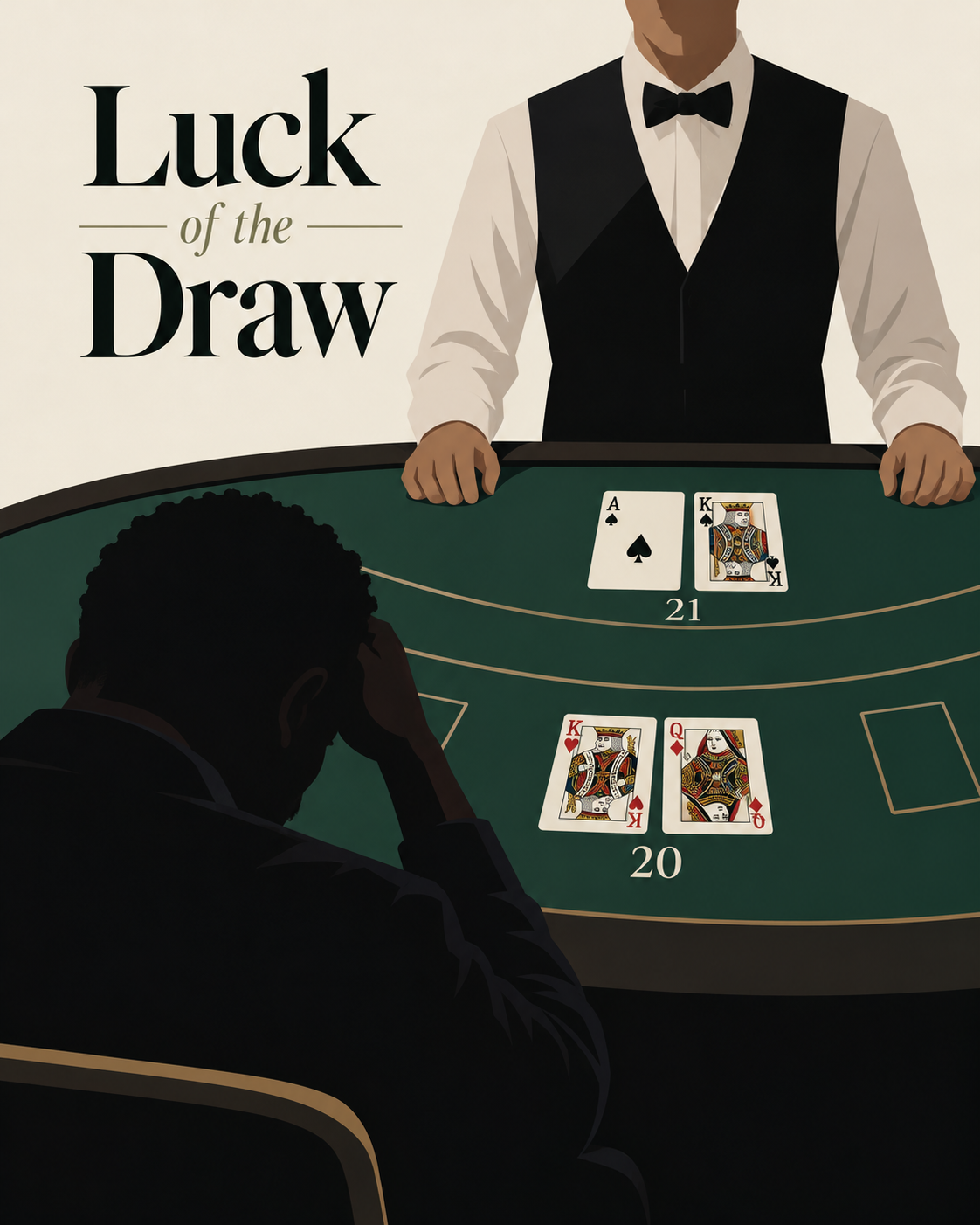
You're dealt a king and a queen. Twenty. A damn near perfect hand. You lean back in your chair, feeling pretty good about yourself. There isn't a decision to make. You stand. The dealer, meanwhile, is showing a six. Perfect. Everything about this situation suggests that you're in a great position to collect your first winning hand.
The dealer flips over his hidden card. Ten. Sixteen. He has to hit.
Out comes a five.
Twenty-one.
Son of a bitch.
You did everything right. You had an outstanding hand. You put yourself in the best possible position to win. And you still lost.
Meanwhile, at the next table over, some drunk guy who can barely keep his eyes open is sitting on a twelve. His dealer is also showing a six. He stands, the dealer draws himself into a bust, and our intoxicated friend collects his winnings. He didn't play a better hand than you. He didn't demonstrate superior skill or judgment. He simply found himself facing a more favorable outcome.
You had twenty and lost. He had twelve and won.
And that's the thing about blackjack. The quality of your hand doesn't always determine whether you win. Sometimes, your fate is simply determined by what's sitting across the table from you.
Gentlemen, welcome to fantasy football.
For sixteen seasons, we've operated under the same basic principle: you play the man across from you, and whoever scores the most points wins. And to be clear, there's absolutely nothing wrong with that concept. Head-to-head competition is the foundation of fantasy football. It's what makes Sunday afternoons interesting. It's what makes Monday Night Football unbearable when you're clinging to a four-point lead against somebody's kicker. It's what gives us the opportunity to talk an unreasonable amount of shit to someone because our imaginary football team happened to outperform theirs.
But the system has a flaw. A pretty significant one, actually.
Your win-loss record isn't always a reflection of how good your team is. Sometimes it's simply a reflection of how fortunate you've been with your schedule.
Take this past week, Week 5, for example. Steve scored nearly 122 points. I put up 130. Will dropped over 140. Three very respectable performances. Three teams that, depending on the week, should reasonably expect to walk away victorious. Yet all three of us took an L. Will, in particular, scored more points than ten of the twelve owners in the league and still walked away empty-handed. Not because his team performed poorly, but because he happened to play Mel, who put up nearly 147 points himself.
Will was sitting at that blackjack table holding two kings, watching the dealer pull a five out of his ass to hit twenty-one.
Meanwhile, consider Zayn. Now, before anybody starts typing in the group chat, this isn't an indictment of Zayn or his team. He's simply the most glaring example of the issue I'm trying to illustrate. Through five weeks, Zayn has scored the fewest points in the entire league, yet somehow finds himself sitting in fifth place. Fifth! In a twelve-man league! A playoff position for the team that has produced less offense than every other roster in the JNIC FFL.
That's not a knock on Zayn. That's a testament to the beautiful, frustrating, and occasionally ridiculous nature of fantasy football. You don't choose your opponents' performances. You can only play the schedule in front of you. And to his credit, Zayn has done exactly that.
But it does raise a question: Should our standings reward the teams that are consistently performing well, or the teams that have simply been fortunate enough to face opponents on their worst weeks?
I'd argue the answer should be a healthy combination of both.
And that's where Wins Against the Median comes into play.
What the Hell Is Wins Against the Median?
I feel like I’ve discussed this before, but for those unfamiliar with the concept, Wins Against the Median is a relatively simple addition to traditional fantasy football scoring. Instead of receiving only one win or loss each week based on your head-to-head matchup, every owner competes in two separate contests. The first remains your traditional matchup against your scheduled opponent. The second is against the league's median score.
In our twelve-team league, the median falls between the sixth-highest and seventh-highest scores each week. Finish in the top six, and you earn an additional win. Finish in the bottom six, and you receive an additional loss.
That means every week, you can finish with one of three possible records:
2–0: You beat your opponent AND scored in the top half of the league.
1–1: You either beat your opponent but finished in the bottom half, OR lost your matchup despite finishing in the top half.
0–2: You lost your matchup AND finished in the bottom half of the league.
The beauty of this system is that it doesn't eliminate the importance of head-to-head competition. Not even close. Your weekly opponent still matters. Rivalries still matter. Upsets still happen. And all the shit talk that makes this league what it is remains very much alive.
What changes is that your overall performance against the rest of the league finally matters, too.
And rather than continue speaking in hypotheticals, I decided to put this theory to the test. I went back and analyzed every matchup, every score, and every owner's performance through the first five weeks of the season. Sixty individual team performances. Thirty head-to-head matchups. Five weeks of data.
And gentlemen, the results are pretty damn interesting.
A Tale of Two Standings
Let's start with what we know. Here are our current standings after Week 5, based on traditional head-to-head matchups. Total points scored serves as the tiebreaker for teams with identical records.
Traditional Head-to-Head Standings — Through Week 5
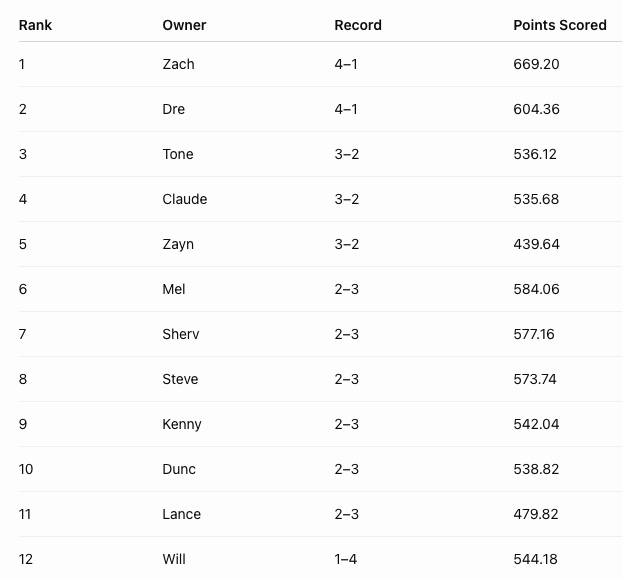
At first glance, nothing seems particularly alarming. Dre and I are leading the pack at 4–1. Tone and Claude are having respectable starts. Zayn is sitting comfortably in fifth. And the remaining owners are fighting to establish themselves as legitimate playoff contenders.
But look a little closer. Specifically, look at the points scored column.
I've scored 669.20 points through five weeks, the highest total in the league. Dre is second with 604.36. Mel, despite sitting at 2–3, has scored 584.06 points, the third-highest total in the league. Sherv is fourth in scoring. Steve is fifth.
And then there's Zayn.
At 439.64 points, Zayn isn't just last in total scoring. He's nearly 100 points behind the next-lowest scoring team and almost 230 points behind the league leader. Yet he's sitting ahead of seven other owners in the standings.
How is that possible? Well, because fantasy football doesn't necessarily reward the team that scores the most points. It rewards the team that scores more points than the one opponent randomly assigned to it.
And therein lies the problem.
Now, let's take those exact same results and apply Wins Against the Median. No changing scores. No rearranging matchups. No creative accounting. Just an additional win or loss each week based on whether you finished among the top six scoring teams.
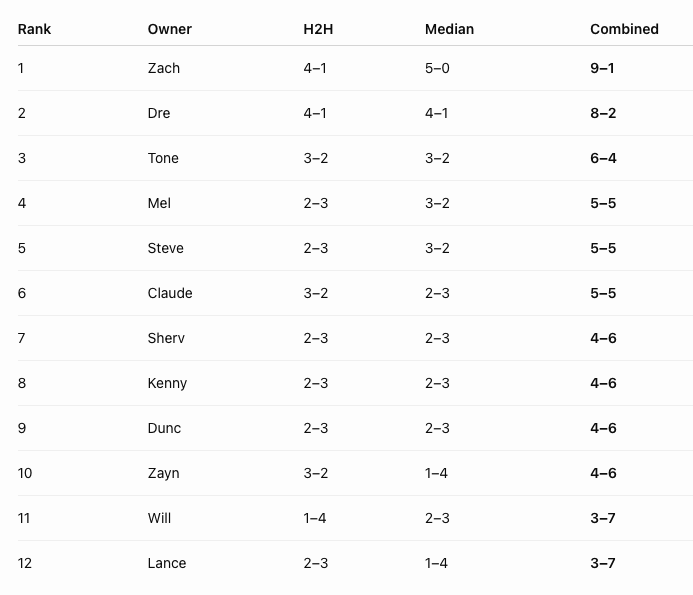
Here's what our standings would look like.
Proposed Standings — Head-to-Head + Wins Against the Median
Now we're getting somewhere.
First, let's acknowledge something important: the top three teams remain exactly the same. Dre and I are still leading the pack, and Tone is still sitting in third place. In other words, introducing Wins Against the Median doesn't necessarily turn the standings upside down. It simply introduces another measurement of performance that helps distinguish the teams that have consistently played well from those that have benefited from favorable matchups.
But take a look at what happens in the middle of the standings. That's where things get interesting.
Mel jumps from sixth place to fourth. Steve climbs from eighth to fifth. Claude slides from fourth to sixth. And Zayn? Our fifth-place playoff contender falls all the way to tenth.
Five spots. From fifth to tenth. Without changing a single point scored or a single head-to-head result.
Let's unpack that for a moment.
The Winners, the Losers, and the Lucky Ones
Mel might have one of the strongest arguments in favor of this system. Through five weeks, he's scored the third-most points in the league, yet he's only managed a 2–3 record. Under the traditional format, he's sitting on the playoff bubble in sixth place. Under Wins Against the Median, he'd be 5–5 and sitting in fourth.
Steve has an equally compelling case. He's scored the fifth-most points in the league but currently finds himself sitting in eighth place, outside the playoff picture. His traditional record is 2–3, but he's finished among the top six scorers three times in five weeks. Under the proposed format, his record improves to 5–5, moving him into fifth place and, more importantly, into playoff contention.
Then there's Zayn. And once again, I'm not picking on the brother. Hell, if anything, maybe we should applaud him for finding a way to win games while scoring fewer points than everybody else. There's an art to surviving in this league, and sometimes the best ability is availability. Or, in Zayn's case, the ability to draw an opponent whose team is having an even worse week than yours.
But the numbers don't lie. Through five weeks, Zayn has finished in the top half of league scoring exactly one time. One. His traditional record is 3–2, but his record against the median would be 1–4. Combine the two, and suddenly he's sitting at 4–6, which, given his scoring output, is arguably a more accurate reflection of his team's performance thus far.
And perhaps the most compelling part of this analysis is that the proposed system doesn't punish Zayn for winning his actual matchups. He still gets credit for every head-to-head victory. He simply doesn't receive the same overall reward as somebody who wins their matchup while also outperforming the majority of the league.
In fact, the playoff implications are significant. Under our traditional format, Zayn is in and Steve is out. Under Wins Against the Median, Steve is in and Zayn is out. Mel also climbs into a more favorable playoff position.
Think about that. We could finish a season with an owner consistently outperforming the majority of the league, only to watch him miss the playoffs because he repeatedly drew unfavorable matchups. Meanwhile, someone scoring significantly fewer points could sneak into the postseason because the schedule happened to break his way.
The Greatest Robbery in JNIC History
Since I've already volunteered Zayn as my guinea pig for one side of this argument, and I'm almost certain he's halfway through drafting a profanity-laced text as he reads this, allow me to use my brother to illustrate the other side of the coin. Zayn, I’ve known you for the better part of two decades; from that first time we linked up on the spades table at Vanessa’s crib in South Orange in ‘04. So I can literally visualize you typing right now, "Ay man, fuck all this median shit. I earned my record! I won my games! Leave me the hell alone!" And you know what? Fair enough.
But my brother, before you hit send on that message, allow me to take you on a little trip down memory lane. Because just four short years ago, you were on the receiving end of what might be the single greatest statistical injustice in the history of the JNIC FFL.
That's right, fellas. In a feat so absurd that it deserves its own exhibit in the JNIC Hall of Records, Zayn became the first and only owner in league history to win the Most Points award AND miss the playoffs. Read that sentence again. This man scored more points than every single owner in the league. More than every playoff team. More than every contender. More than yours truly, the eventual champion that year. Week after week, Zayn walked up to the blackjack table holding two face cards, only to watch the dealer pull another twenty-one out of his ass. The man wasn't just losing games. He was being subjected to a level of scheduled misfortune that should've warranted an investigation by the FBI. And when the dust settled, despite being the highest-scoring team in the entire league, Zayn finished with a 6–8 record, a 9th-place finish, and a front-row seat to the playoffs he had absolutely no business missing.
But hold on, because somehow, the story gets even more ridiculous. That very same season, while Zayn was busy putting up league-leading numbers and yet collecting losses like frequent-flyer miles, Sherv was on the other side of the casino holding 12s and 13s on every hand and somehow walking away with stacks of chips. In the same season, Sherv scored THE FEWEST POINTS IN THE ENTIRE LEAGUE. Dead last. Twelfth out of twelve.
And what was his reward for this offensive shit show? Not only did this man make the playoffs; he made it all the way to the finals and finished second in the league! Gentlemen, I need you to understand the sheer insanity of what I'm telling you. In the SAME season, the owner who scored the MOST points finished NINTH and missed the playoffs entirely, while the owner who scored the FEWEST points finished SECOND and played for a championship. The best offensive team in the league was watching the postseason from the couch while the worst offensive team was sixty minutes away from hoisting the trophy. You couldn't make this shit up if you tried. If I pitched this storyline to Hollywood, they'd send me back to the writers' room and tell me to make it more believable. The man who scored the most couldn't get in. The man who scored the least almost won the whole damn thing.
And if that doesn't illustrate why we need to at least consider Wins Against the Median, then I genuinely don't know what will. So Zayn, before you curse me out for suggesting a system that would drop you from fifth to tenth this season, remember that four years ago, this exact same system might have saved you from the most egregious robbery this league has ever witnessed. Funny how that fantasy football blackjack table works, ain't it? Sometimes you're the guy getting robbed by the dealer. Other times, you're the drunk fucker at the next table holding a 12 … yet collecting chips.
Now, is that inherently unfair? Maybe not. Everyone plays under the same rules, and sometimes the schedule works in your favor. But is it the most accurate way to identify the six best teams in our league?
That's the question I'm asking.
Tradition Versus Progress
Now I know, even after highlighting one of the most egregious statistical anomalies in our leagues history, there will still be a few of y’all who would make the argument, "That's fantasy football, Commish. You play who you play. Sometimes you get lucky, sometimes you don't." And there's truth in that. Hell, some of the most memorable moments in JNIC history have come from somebody stealing a victory they had absolutely no business winning. Those moments are part of the fabric of this league.
But here's the thing: Tradition and improvement aren't mutually exclusive.
We can preserve what makes this league special while recognizing opportunities to make it better. And fairness doesn't mean eliminating the possibility of an upset. It means making sure that one unfortunate matchup doesn't completely erase an otherwise excellent week of performance.
I've always believed that over the course of a season, the best teams should generally rise to the top. Not necessarily the teams with the best names, the most recognizable players, or even the most impressive single-week performances. I'm talking about the teams that consistently put themselves in position to win. The teams that draft well, manage their rosters, navigate injuries, work the waiver wire, and make the right lineup decisions more often than not.
Those things should matter. And our standings should do a better job of reflecting them.
And let's not pretend that Wins Against the Median would eliminate the possibility of somebody getting hot at the right time and making an unexpected championship run. It wouldn't. Our six-team playoff structure would remain intact. Head-to-head matchups would still determine who advances each week. The unpredictability, the upsets, the heartbreaking Monday Night Football finishes, and the inevitable championship celebrations from somebody who spent half the season being called a fraud would all remain very much alive.
We're simply talking about introducing another layer of accountability during the regular season.
After all, this is a league where twelve grown men spend hundreds of dollars and an unreasonable amount of time managing fictional football franchises. We scout rookies. We analyze trade offers (95% of which never come to fruition). We study injury reports. We debate waiver claims. Some of us have probably spent more time researching our fantasy football teams than we've spent reviewing our own investment portfolios.
And yet, after all that effort, the difference between competing for a championship and watching the playoffs from the couch could come down to whether your opponent happened to have a good week or a bad one.
There's a certain amount of absurdity in that.
We've spent sixteen seasons building a league with history, tradition, rivalries, championships, and enough archived disappointment to fill a museum. As we continue to evolve, I think it's worth examining whether some of the rules and structures we've grown accustomed to are actually the best ways to reward competition.
Wins Against the Median isn't perfect. No scoring system is. And I'm not suggesting we rip up the Constitution and change the rules in the middle of the season. But I do believe it's a conversation worth having as we consider the future of the JNIC FFL.
Because ultimately, the goal isn't to take luck out of fantasy football. That's impossible. And frankly, a little luck is what makes this shit fun. Every champion in this league has benefited from a fortunate bounce, a favorable matchup, or an opponent's inexplicably terrible lineup decision at some point along the way. That's part of the game.
The goal is to make sure luck doesn't have a bigger voice in determining our champion than the actual performance of the teams competing for it.
And maybe that's the lesson from that imaginary trip to Vegas. You can study the game, make all the right decisions, and play your hand as well as humanly possible. Sometimes the dealer is still going to pull that five and ruin your night. That's life. That's gambling. That's fantasy football.
But imagine if, at the end of the night, that casino decided to recognize not only the players who happened to beat the dealer, but also the players who consistently put themselves in the strongest position to win. Wouldn't that give us a more complete picture of who actually played well?
Because over time, I'd rather put my money on the guy consistently holding twenty than the guy celebrating another lucky win with a shitty hand.
And if we're going to spend seventeen weeks arguing about who's the best in this league, shouldn't our standings do a better job of helping us answer that question?
Just something for y'all to ponder.
